
Xi Jinping's Visit Amidst a Rattling of Cyber Sabers
Being a sequence of quotations from contemporary articles contextualizing the visit of the rising Vice President of China amidst a conspicuously timed introduction of unprecedented domestic cybersecurity legislation.
National Post Full Comment (Feb 14) - "From bitter gruel, Xi Jinping to ascend to China's top job" by Peter Goodspeed
http://fullcomment.nationalpost.com/2012/02/14/xi-jinping/
Now vice-premier, Mr. Xi is widely expected to replace President Hu Jintao as secretary-general of the Chinese Communist Party in October, when China will change 60% of the members of the party’s Central Committee and replace seven of the nine members on the ruling Standing Committee of the Politburo.
By spring 2013, he should replace Mr. Hu as president, then become chairman of the Central Military Commission.
Meanwhile...
Hillicon Valley (Feb 13) - "Senate cybersecurity bill would let firms appeal Homeland Security regulations" by Gautham Nagesh
http://thehill.com/blogs/hillicon-valley/technology/210349-senate-cybersecurity-bill-would-let-firms-appeal-regulations
But designated sectors would have the right to appeal whether the regulations apply to them. Several groups representing portions of the private sector considered part of the critical infrastructure have expressed concern about the impact of the regulations on both security and the bottom line.
"Passing the bill is crucial for national security, but not if the provisions on critical infrastructure regulation are watered down. This will be a real test for this Congress," said James Lewis, senior fellow and director at the Center for Strategic and International Studies.
James A. Lewis is one of the star witnesses for <a href="http://www.hsgac.senate.gov/hearings/securing-americas-future-the-cybersecurity-act-of-2012" title Securing America's Future: The Cybersecurity Act of 2012"">the Senate Homeland Security and Governmental Affairs Committee's hearing this Thursday on what has been termed "comprehensive" cybersecurity legislation being unveiled by Majority Chair Joe Lieberman and co-sponsor Minority Chair Susan Collins. Senator John (Jay) Rockefeller IV is the other primary co-sponsor, and will be the first witness at Thursday's hearing.
After determining which firms are critical infrastructure, DHS would then, in consultation with the private sector, determine cybersecurity performance requirements for firms in the covered sectors.
...
"There would be a huge market incentive for designated sectors to meet the security standards. But if they don’t DHS and the AG would decide on penalties," said the spokesman.
What about international cybersecurity standards and practices?
WSJ (Jan 27) - "China's Cyber Thievery is National Policy---And Must Be Challenged" by former NSA Director Mike McConnell, former Secretary of DHS Michael Chertoff, and former Deputy Secretary of Defense William Lynn.
http://online.wsj.com/article/SB10001424052970203718504577178832338032176.html
This appears to be a copy liberated from between the lines of Rupert Murdoch's curious digital divide:
http://defense-technologynews.blogspot.com/2012/02/dtn-news-defense-intelligence-news.html
Cyberspace is an ideal medium for stealing intellectual capital. Hackers can easily penetrate systems that transfer large amounts of data, while corporations and governments have a very hard time identifying specific perpetrators.
Stewart A. Baker, another witness for Thursday's hearing, on the metaphorical wall isolating domestic and foreign intelligence gathering: "I thought that the civil liberties dangers it was supposed to ward off were probably more theoretical than real."
http://www.skatingonstilts.com/skating-on-stilts/tired-of-reading-chapters-backwards.html
Continuing with the perspectives expressed in the WSJ:
Congress and the administration must also create the means to actively force more information-sharing. While organizations (both in government and in the private sector) claim to share information, the opposite is usually the case, and this must be actively fixed.
National Journal (Feb 13) - "Feinstein Introduces Information-Sharing Bill Ahead Of Senate Cybersecurity Debate" by Josh Smith
http://techdailydose.nationaljournal.com/2012/02/feinstein-introduces-informati.php
"Alongside terrorism, cybersecurity is perhaps the number one threat facing our nation today, but many obstacles exist that prevent the cooperation and coordination needed to deter this growing threat," Feinstein said in a statement.
NextGov (Feb 13) - "DHS budget would double cyber spending to $769 million" by Aliya Sternstein
http://www.nextgov.com/nextgov/ng_20120213_7454.php
There is bipartisan support for improving computer network defenses, so the outlook may be positive for obtaining much of the proposed $769 million from Congress. The funding would go toward the National Cyber Security Division for protecting federal networks and coordinating with the private sector on safeguarding critical infrastructure systems such as utility grids.
For perspective:
U.S. Department of Defense (Feb 13) - "DOD Releases Military Intelligence Program Requested Top Line Budget for Fiscal 2013"
http://www.defense.gov/releases/release.aspx?releaseid=15058
The department determined that releasing this top line figure does not jeopardize any classified activities within the MIP. No other MIP budget figures or program details will be released, as they remain classified for national security reasons.
What is the mood of the Senate, and the posture towards the private sector?
United States Senate Democrats (Feb 9) - '[Senate Majority Leader Harry] Reid Outlines Process For Cybersecurity Legislation, Including "Fair and Open" Amendment Process [in letter to US Chamber of Commerce CEO Tom Donohue]':
http://democrats.senate.gov/2012/02/09/reid-outlines-process-for-cybersecurity-legislation-including-%E2%80%9Cfair-and-open%E2%80%9D-amendment-process/
greater than terrorism
Yet, addressing cyber security is not simply a matter of staving off a future threat; it demands that we stop the hemorrhaging of national security secrets, intellectual property, and jobs already underway. In a recent letter to Senate Republican Leader McConnell and myself, eight former high-ranking national security officials led by Secretary of Homeland Security Michael Chertoff and Secretary of Defense William Perry pointed out that, not only are critical infrastructure such as power plants and hospitals at risk; moreover, “foreign states are waging sustained campaigns to gather American intellectual property – the core assets of our innovation economy – through cyber-enabled espionage.” They counseled that the “constant barrage of cyber assaults has inflicted severe damage to our national and economic security, as well as to the privacy of individual citizens. The threat is only going to get worse. Inaction is not an acceptable option.”
At this point, all signs indicate informed consensus for this legislation to pass quickly through Committee into an opportunity for debate culminating in passage through the Senate.
In closing, witness Stewart A. Baker from his text Skating on Stilts: Why We Aren't Stopping Tomorrow's Terrorism, (Stanford, California: Hoover Institution Press, 2010), p. 5-6.
http://www.skatingonstilts.com/skating-on-stilts/tired-of-reading-chapters-backwards.html
That was the theory, anyway. In practice, the wall crippled our last, best chance to catch the hijackers before September 11, 2001. In August of that year, the wall kept the FBI from launching a fullscale criminal search for the hijackers—even though all of our security agencies were expecting an imminent al Qaeda attack, and even though both the FBI and the Central Intelligence Agency (CIA) knew that two dangerous al Qaeda operatives had entered the United States. The failure to track those operatives down wasn’t a matter of incompetence or a failure to communicate, at least not in the last weeks. FBI criminal investigators spent the last part of August begging for a chance to track the terrorists. They were shut down cold—by lawyers who told them the wall simply could not be breached.
I wasn’t the most enthusiastic proponent of the wall. I thought that the civil liberties dangers it was supposed to ward off were probably more theoretical than real. But I saw no harm in building in an extra margin of protection for civil liberties. If nothing else, the wall would reassure privacy advocates in the courts, in the newspapers, and on Capitol Hill that intelligence would not be misused. It was insurance, not just for civil liberties, but for the intelligence agencies themselves. For both reasons, I thought, it was best to keep the wall high.
It made eminent sense inside the Beltway.
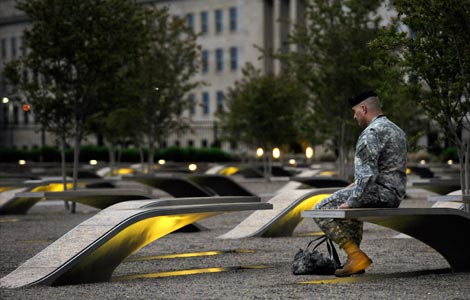
Until the world outside the Beltway broke through, just a few yards from where I’m standing.
Will the world outside the Beltway be heard in the composition of these new laws and during the creation of these new authorities? Are the new cyber sabers already rattling?